MY STORY
INTRODUCTION
My grandfather was a journalist and writer, for whom the written word had power, value and durability. My father, brother and I kept a list of “Schlaverisms” when we were younger. They were our own family slang that had meaning only to each other.
As I struggled to wrap my head around separation from my wife, my Dad shared his journal that he kept when he was working through his divorce. In the final days of my father’s life we read through the annual Christmas Letters that his Dad would send chronicling the year’s news for the family. The “Christmas Chimes” are preserved here and reading through these with my father impressed upon me the importance of recording and writing our own stories down.
After my father died I discovered that a sister, of whom I knew little, had written an autobiography and recorded it as a podcast. Those words completely transformed my understanding of my own past.
I write these words, share these stories, so that I may preserve them for my son and for those who wish to join me as I seek to know WHAT I AM.
Origin Story
When you are expected to introduce yourself to a new person or a group, what do you say? Relatively few people logically start with the city or year they were born in. While this is the actual beginning, temporally at least, of their lives - most people tend to give their name and list their profession or their passion. It takes time to realize that the way you tell your own story might be a little different, a little unusual. For most of my youth, when we were going around the room making our introductions, I would say: “My name is Beep, I was born in a pink house on a waterbed.” That is the beginning of my story. I really don’t know why the color of the house matters, other than it is about as unusual as being born on a waterbed. It tells you that what you are going to experience next is going to be unique. I am unique. And so that is how my story begins. In Cottage Grove, Oregon, where the movie Stand By Me was filmed. If you haven’t seen the movie, you really should. Rob Rhiner made a masterpiece of Americana with that one. The scenes where the protagonists walk along train tracks between tree covered hills - that is all I know about where I was born other than my father’s stories of driving down dangerous logging roads with thundering trucks bearing down. My family was only in the house in Oregon for a short period of time, and by two years of age I had already traveled down to California and across the USA to the East Coast. Here is the next part of my story: my parents didn’t have a name for me. My birth certificate says “baby boy.” When I was born, my lungs weren’t quite developed, and I made these little beeping noises in my sleep. My parents, so I was told, turned to one another and said “we have a little Beeper!” And so I was called Beeper, and it was shortened eventually to just “Beep.” A couple years after I was born, they officially named me Julian after Julian Bond the civil rights organizer and Julian Bream the classical guitarist. I went by Beep through high school until I moved to New York when I finally embraced the name Julian and started introducing myself that way. When my Dad recalled my origin story with just the family around, he would add that it was the Sunshine Motel, in Colorado, in which I was conceived. He knew the time and the place when it happened and that felt kinda special to me. My parents were hippies. I was born in 1976, in December, and they set aside the placenta and afterbirth in a pot near the stove to the utter disgust of my sister and brother who bore witness.A hero wants to feel like there is something special about their origin which aligns with some prophecy or destiny. I had a unique beginning and held out hope for some sort of fated glory for most of my life. So I started living. I was the child of a single dad in a rent controlled apartment, self conscious, driven and unable to get out of my own way. When we moved to Massachusetts, my Dad was able to get full custody of my half-sister, my brother and me at the age of three. At the time, in 1979, this was a rarity for a man. He found an apartment through the Cambridge Food Co-Op bulletin board and that is where I grew up. I was a poor white kid in a city full of culture and I was lucky.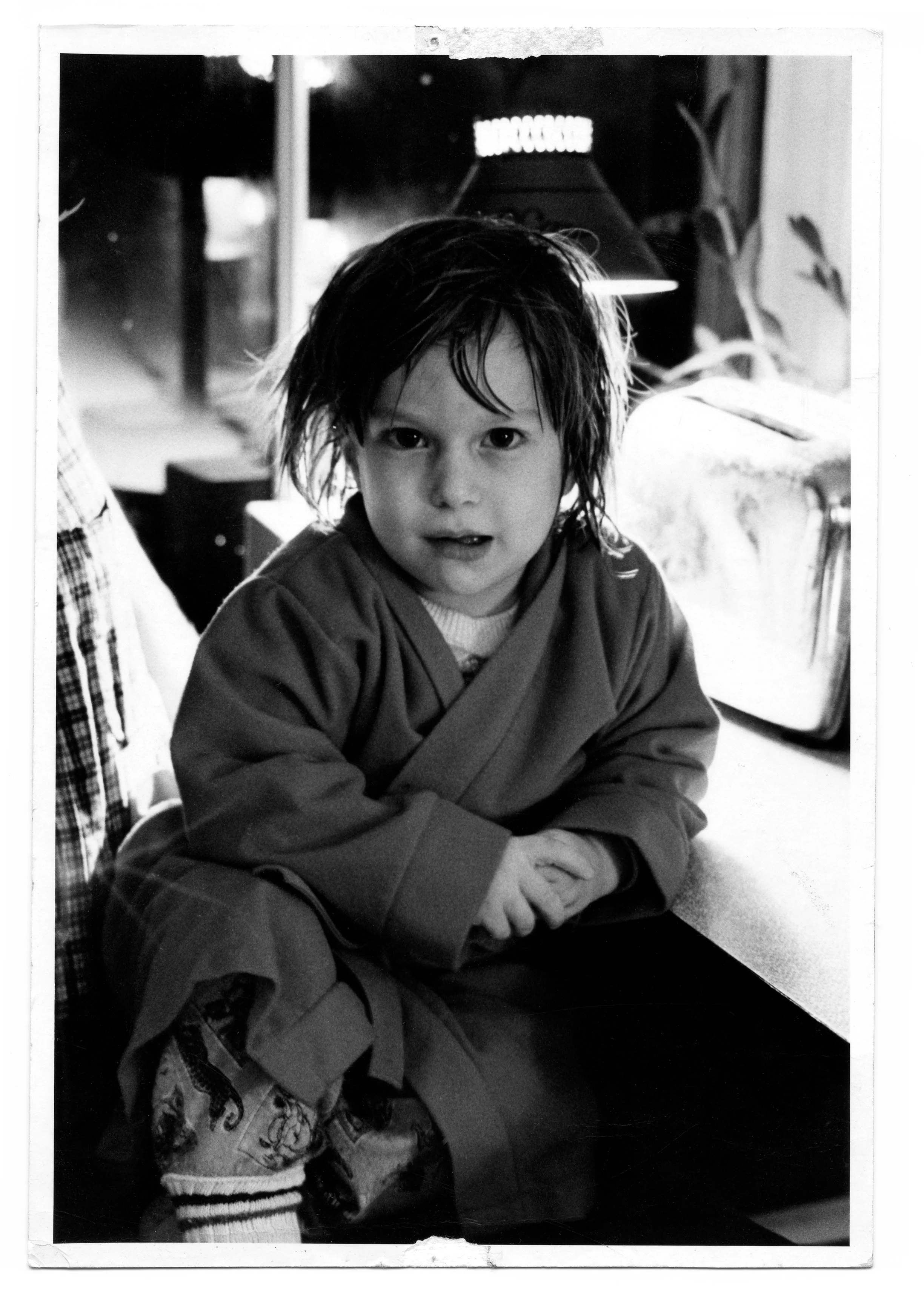
My Hippie Parents
The simplified version of how my parents met was that my Dad, Paul, was a social worker and my Mom, Diana,  was a case who showed up with a boy and three girls. My father ended up marrying Diana and he found a school bus that had been turned into a camper. My brother Ben was my Dad’s first born and I followed, four years later, his only other son. Many years later he would expand on that story. He was organizing a “Meat Share,” a kind of CSA where different families would go in together on a side of meat and divide it up. Diana showed up at the meeting and must have offered to take notes and so they met. Pretty different story. At the end of the day, it was the 1970’s and they were hippies.

As I came to understand growing up, there were different types of hippies. Some were into drugs, intoxicated by the music, open to love and free spirited. Others were driven by politics and social change. To the best of my understanding, my hippy parents were the granola kind. They literally made granola in the kitchen of someone they knew who owned a restaurant and sold it along with muffins and other things they would bake. I guess there were many other people, at the time, living like that and it wasn’t weird. What did seem a little weird, and something my Dad was guarded about, was that along the way the three eldest kids would get “dropped off” at communes or with other families. There wasn’t a lot more to the story that I knew. I heard of these siblings, and would briefly meet my older brother Tony when I was young before he passed away. Kristina, the oldest, lived near me in Cambridge when I was growing up and I remember walking by her on the street occasionally.  I would say ‘Hello’ and walk right past her, each time wondering at how weird it was to say ‘hello’ to a sister as you would say to someone who was barely an acquaintance.

Many of my friends had divorced parents or single parents. I was the only one among my classmates, it seemed, who had family who were mostly strangers. I still to this day can only think back to two memories of my mom. I remember her showing up with a box of children’s books, a series of colorfully bound hardcovers called “Serendipity.” They were several years behind my reading level at the time. I hung onto these books simply because they were the one and only thing I can remember about my mom. She showed up one sunny afternoon outside our apartment and fished them out of the back seat of a car. I don’t think they were even wrapped, they were probably in the same box that someone had set them out on the curb in.

Later, when I was maybe thirteen, I remember meeting up with her in Harvard Square near the chess tables outside of what was the Au Bon Pon cafe. She had her youngest son, Andrew, with her. This was the only time I would meet him. I don’t really remember much from that encounter. I can’t even remember if we hugged though I assume we did. It was also a sunny day.

My brother remembers seeing her digging through trash and cardboard boxes in our neighborhood when she was living in a shelter nearby at some point. I had to fill in that empty space in my mind and heart with images of her from photographs and the few stories I would hear from my siblings or my Dad. The most frequently told story was of the weekend my Dad got us permanently, the weekend she went off to see the Pope.

My mother was Italian. Her parents were very Italian. Frank and Angelina. He drove a bulldozer and they were from Frozinone. Angelina wanted a new dining room table, and when Frank said there was nothing wrong with the one they had, she took a saw and cut their table in half.

By the time I was two and a half years old, after my parents had returned to the east coast, my Dad had found a small apartment and spent the next six months trying to regain custody of my brother Ben, my sister Lisa, and me. Mothers were almost always given primary custody of kids when couples separated at that time. My Dad, who was working in a nursing home as a cook, would take a long bus ride to pick us up when he had visitations. And on this one fateful day, when he arrived, my sister Lisa proudly announced that she had been taking care of us and feeding us Twinkies that she had stolen from the corner store downstairs. My mother was gone. She had left at the beginning of the weekend to go to New York City to see the Pope and only left a note. I was three, my brother seven, my sister thirteen.

This was finally enough for my Dad and he decided to take matters into his own hands. He packed up our things and we all got on the bus to Cambridge. Hearing this and the other tales he had recorded was enough for the judge to grant him full custody. As you can imagine, it was pretty easy for me to gather from that story that my mom was a bad mom and we weren’t very important to her. My First Home
My Dad needed to find an apartment big enough to accommodate the three kids before he could move us in. Prior to the Pope’s visit, my Dad saw a posting on a bulletin board in the Cambridge Food Co-Op in Central Square. Squatters were living in a 4-unit around the corner and some homeless people lit a fire in the basement of one of the units. So the other squatters (which means living without paying rent or owning the property) made a flyer looking for new neighbors and posted it at the Co-Op. My Dad moved in. He wasn’t paying any rent, and had found himself a place that was big enough to accommodate the kids. I’m really not sure how long this arrangement lasted. As he told it, it lasted until the furnace broke. He and the other people in the building then tracked down the landlord, who fixed the furnace and they all started paying $125 a month in rent. A few decades later when he moved out of that same apartment his rent had only increased to $235. We did have a new landlord by then, a sweet and generous woman named Adeline who built a chicken coop under her kitchen sink when she first moved into the apartment upstairs from our own. We had a rainbow sticker with a unicorn on our front window of the apartment. Buses that connected the neighboring towns and they would come together in Central Square down the street from our apartment and they would thunder by day and night. In those early days I would help him stuff envelopes to make extra money next to the open window, and of course, we all worked our shifts at the food Co-Op.We did visit “the Bus” once in the junk yard where it rested after they made it to the Boston area. It was a school bus, grey, not full length, that a man meticulously converted to a camper. He installed a kitchen behind the driver’s seat, bunk beds on either side of the aisle, and a bathroom in the back. By then it had broken windows and had been stripped of its contents, still, it was so cool to me seeing it for what seemed like the first time. There were padded rails to hold the glasses in place in the kitchen cabinet and there were compartments under the center aisle which my Dad said had every tool you needed to work on the engine. I remember walking to the bathroom in the back, imagining what it must have been like to sit on the toilet and make eye contact with the driver following behind. The bus went with them to California, and back to the East Coast. Across the front was the word “Redoubt” which is a word for fortress or secure retreat. The story he told the most was about the time the engine blew on the top of Mt. Shasta and he coasted down until they found a pig farm where we stayed until the truck was repaired. It was there that my mom lost her ring and my Dad, surveying the mud and pig excrement decided not to bother to look for it. Until now, I don’t think I quite realized that for the next several years after the “I was born on a waterbed in a pink house" moment I was, what we would consider today, unhoused. Central Square, where I would grow up, seemed to always have homeless people present long after we started paying rent and I began to go to the public school. There was a little alley way next to our apartment and this frequently was a pee stop for drunks, a place for pick pockets to paw through purses and leave behind the unvaluables and our front stoop was a terrific resting place for those whose journey was neverending. For many years there was a methadone clinic and shelter up the street from our home, and when it moved out of the area the operators arranged for a daily van transport across the street from my stoop for its customers. I was a latchkey kid, which means as the child of a single parent, I had to walk home from school, let myself in, make my own snack and entertain myself. And most of the time, with my key in hand, I needed to thread the gauntlet of addicts that were sitting on my front steps. The term ‘latchkey kid’ goes back to the 1940’s when the word ‘latchkey’ meant house key and both parents had to go to war or work in the factories. It came back with the rise of single parents and dual incomes in the 70’s and 80’s. And while it made me very self reliant, I was often terribly bored and lonely. I remember wishing with all my heart for a mom to be home waiting for me with hot chocolate chip cookies. I remember when I was very little and unable to pour the full gallon container of milk, for fear of spilling it, I would use water from the faucet in my cereal. It was disgusting. One afternoon, shortly after we had gotten our first personal computer, I sat playing an ASCII game and startled when I heard a noise behind me. A sniffling and farting dirty old man emerged from my basement holding a blanket. He had grabbed one from my bunkbed and gone down to the dark basement to sleep. Another day, when I had also failed to lock the door behind me, I turned to see someone walking out the door with our new CD player. I chased this one down the street and grabbed it back in a fit of adrenaline with a toy wooden sword. The apartment had two bedrooms, however you had to walk through one to get to the other. My brother and I had a bunk bed and there was a blanket instead of a door to this room. In 1981, when I was 5, my dad found a job in the Fuel Assistance office for the City of Cambridge and also enrolled in night classes at the New England School of Law. This effectively meant that he would come home after work and whip up dinner before heading to class about an hour and a half later. He wouldn’t return until after it was our bed time and this meant that we would miss the absolutely crucial “tuck in” which I felt was a massive injustice. Our solution was to create ‘booby traps’ and so before brushing our teeth and getting our pj’s on, my brother and I would string up beer cans and pots and pans behind the curtain to our room so we would be awakened by the clatter when my father finally came home and could be properly tucked in. His room had a door which was never closed and his pillow was about 10 feet from my own on the top bunk. My active mind would race as I tried to sleep and it was always very difficult for me to drift off. I would lay in bed listening to my father’s breathing as he slept, reassured by his presence and the sound of my brother below. But at times my Dad’s breathing would suddenly stop and I would begin to panic. Was he ok? I would throw the blanket back and swing my leg over the ladder just as he would start breathing again. Love and trauma all at once.