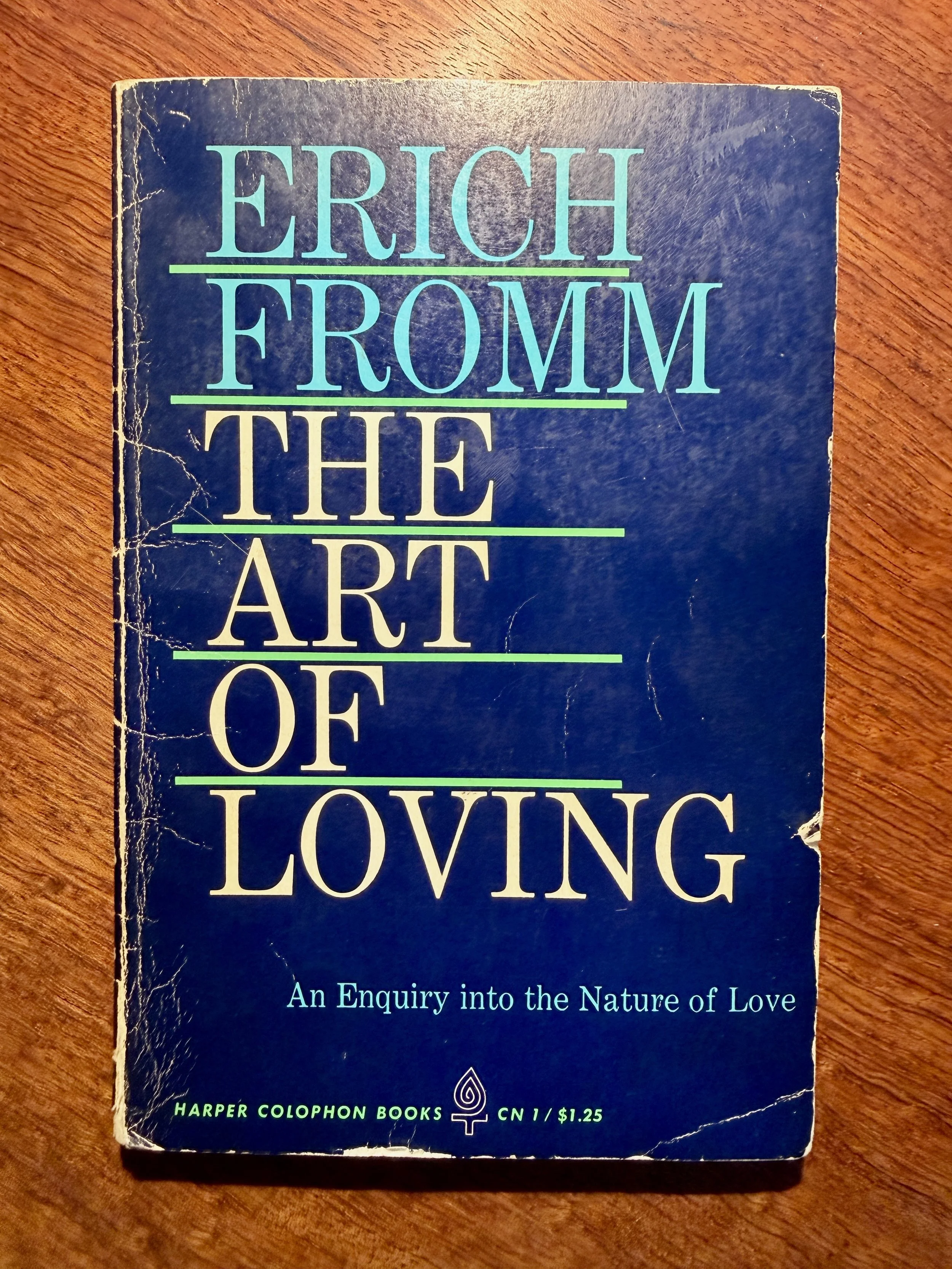
An Enquiry into the Nature of Love - Erich Fromm
The forward of this short book sets the expectations immediately: this is not an instruction manual. The Art Of Loving, ends up as a rather detailed psycho-philosophical analysis of ‘maturity’ which is a precondition for being able to experience life as love. Like most of the German philosophers that I have read, his words are precise and stack into sentences that seem best read singly and then re-read.
“He who knows nothing, loves nothing. He who can do nothing understands nothing. He who understands nothing is worthless. But he who understands also loves, notices, sees. . . . The more knowledge is inherent in a thing, the greater the love. . . . Anyone who imagines that all fruits ripen at the same time as strawberries knows nothing about grapes.”
Paracelsus
As Mr. Fromm dives into his enquiry he lays out his theory of man and love as the answer to the problem of human existence. “Man–of all ages and cultures–is confronted with the solution of one and the same question: the question of how to overcome separateness, how to achieve union, how to transcend one’s own individual life and find at-onement.” (Erich Fromm, The Art of Loving, Harper Colophon Books 1962 Edition page 9)
The modern man is seeking ‘union’ in a variety of ways which he enumerates along with their more obvious flaws. Orgiastic union, creative pursuits, sameness with others, etc are all touched upon in the examination of things people associate with love and its pursuit. The consumption of man in all things was clearly dominant in 1956 as he writes. He describes man wanting to ‘transcend’ and return to pre-Adam divine perfection as he looks over his land and home.
Fromm examines Freud and the conception that instinctual and sexual satisfaction are fundamental and points out where this analysis goes astray. Fromm posits that love is the outcome of psychology. He also leans heavily on Marx as he talks about society and what characterizes a higher, or more mature, way of living. He also goes deeply into religion and the love of God connecting the Golden Rule with the concept of “loving thy neighbor” or brotherly love. If one can love one person less than another can they love at all?
The discussion of motherly love and fatherly love is written from the perspective of a psychoanalysis and details some of the impacts and neurosis that he feels are the result of parents being stingy or too generous with their love. Many of these passages impacted me, including one in which describes a “form of neurotic pathology” where there is attachment to the father.
“A case in point is a man whose mother is cold and aloof, while his father (partly as a result of his wife’s coldness) concentrates all his affection and interest on the son. He is a “good father,” but at the same time authoritarian. Whenever he is pleased with the son’s conduct he praises him, gives him presents, is affectionate; whenever the son displeases him, he withdraws, or scolds. The son, for whom father’s affection is the only one he has, becomes attached to father in a slavish way. His main aim in life is to please father–and when he succeeds he feels happy, secure and satisfied. But when he makes a mistake, fails, or does not succeed in pleasing father, he feels deflated, unloved, cast out. In later life such a man will try to find a father figure to whom he attaches himself in a similar fashion. His whole life becomes a sequence of ups and downs, depending on whether he has succeeded in winning father’s praise. Such men are often very successful in their social careers. They are conscientious, reliable, eager–provided their chosen father image understands how to handle them. But in their relationships to women they remain aloof and distant. The woman is of no central significance to them; they usually have a slight contempt for her, often masked as the fatherly concern for a little girl. They may have impressed a woman initially by their masculine quality, but they become increasingly disappointing, when the women they marry discovers that she is destined to play a secondary role to the primary affection for the father figure who is prominent in the husband’s life at any given time; that is, unless the wife happens to have remained attached to her father–and thus is happy with a husband who relates to her as to a capricious child.” (Ibid. pgs 97-98)
And so one must conquer their neurosis, and live their lives with the principles of care, responsibility, and respect towards others and themselves. In maturing, one gains the knowledge and understanding that we are not and will not be omnipotent and omnipresent. That we really are helpless and must be humble. From here, we must next be productive. In doing, and in being, active (e.g “he who does nothing, understands nothing”) we gain knowledge and understanding.The key understanding is that we find transcendence and union in the act of loving and in actively loving. This higher form of loving is love for all, it is being present, and it is aligned with that zen state of oneness in understanding both the powerful connections and fleeting insignificance of life.
“Love is possible only if two persons communicate with each other from the center of their existence, hence if each one of them experiences himself from the center of his exist-ence. Only in this "central experience" is human reality, only here is aliveness, only here is the basis for love. Love, experienced thus, is a constant challenge; it is not a resting place, but a moving, growing, working together; even whether there is harmony or conflict, joy or sadness, is secondary to the fundamental fact that two people experience themselves from the essence of their existence, that they are one with each other by being one with themselves, rather than by fleeing from themselves. There is only one proof for the presence of love: the depth of the relationship, and the aliveness and strength in each person concerned; this is the fruit by which love is recognized.” (Ibid. pg 103)