1965
WRITE OR NOT, IT'S BEEN FUN
Past becomes prologue and before it is too late, it is time to put into print, be it repetition, some of the paragraphs written and spoken during 38 years of newspaper and magazine work. The trail of memories stretches from Sparta, Wis. to Mount Prospect, Ill. and encompasses the Rice Lake (Wis.) Chronotype, the Kewanee (Ill.) Star-Courier, the Chicago Daily News and Chicago’s American, Office Appliances to executive editorship of The QUILL of Sigma Delta Chi. Privately printed as a Christmas message to my friends this little booklet is dedicated to my wife, Betty, sons David and Paul, and daughter Marcia who have shared many of these years of journalism.
THE SCHLAVER CHRISTMAS CHIMES Mt. Prospect, Ill. Dec. 25, 1965
This little booklet replaces the usual Schlaver mimeographed message for 1965. It provides an opportunity for Dad to get some journalistic nostalgia off his chest, while at the same time we as a family wish our friends near and far, old and new, a Merry Christmas and a Happy New Year. This greeting comes from C. O., enjoying his editorship of The QUILL and a respite from village presidency; from Betty, still in the banking profession; from David, continuing his studies at Moreau Seminary across the lake at Notre Dame; from Paul, a busy junior at the university with the Golden Dome; and from Marcia, a senior at Regina Dominican High School, part-time checker at Jewel (Randhurst) and proud possessor of her driver's license.
(Illustrations are by Marcia)
TAKE THE X OUT OF CHRISTMAS
This is no time to write X-mas with x representing an unknown quantity. Christmas is more than that, it is real, it is here. We should call it Christmas because it denotes the birth of Him who was called the Prince of Peace. He, too, came in troubled times somewhat akin to those of today when our nation wears the cross of Viet Nam.
Christ was born while his parents were on a tax-paying pilgrimage in the midst of a housing shortage. There was no room for Him in the inn. His people were burdened and oppressed. He was ridiculed, betrayed, persecuted, tortured and crucified. Yet today, still across the centuries, he speaks to six hundred million people who call him Savior.
Yes, He is a known quantity. The very custom of giving gifts at Christmas rose from the fact that Christ was the great gift to the world. Until one feels the real spirit of Christmas, there is no Christmas. All else is outward display—so much tinsel and so much decorations.
It isn’t the holly. It isn’t the snow. It isn’t the tree. Nor the firelight's glow. It is the warmth that comes to hearts of men when the Christmas spirit returns again.
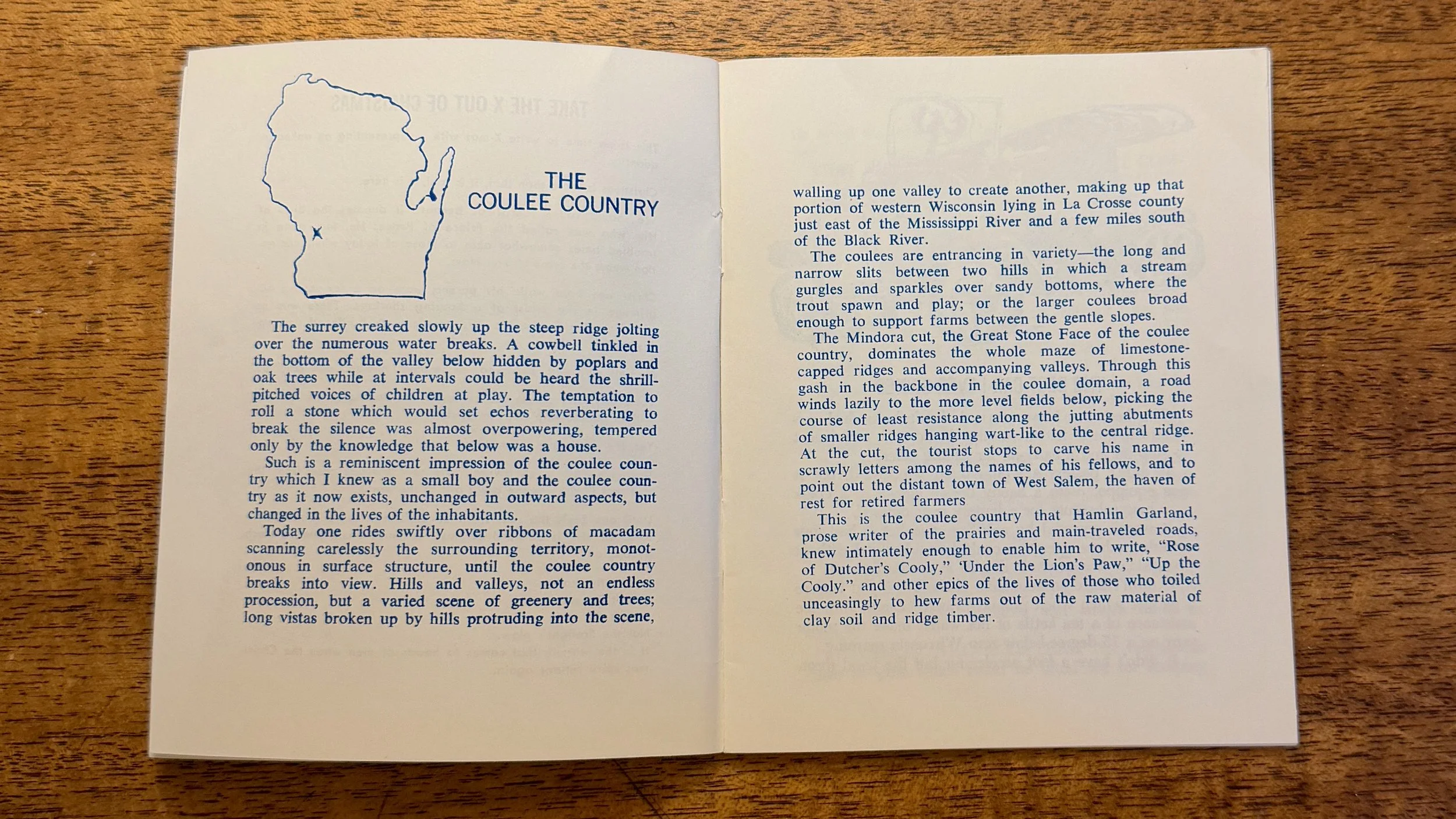
THE COULEE COUNTRY
The surrey creaked slowly up the steep ridge jolting over the numerous water breaks. A cowbell tinkled in the bottom of the valley below hidden by poplars and oak trees while at intervals could be heard the shrill-pitched voices of children at play. The temptation to roll a stone which would set echos reverberating to break the silence was almost overpowering, tempered only by the knowledge that below was a house.
Such is a reminiscent impression of the coulee country which I knew as a small boy and the coulee country as it now exists, unchanged in outward aspects, but changed in the lives of the inhabitants.
Today one rides swiftly over ribbons of macadam scanning carelessly the surrounding territory, monotonous in surface structure, until the coulee country breaks into view. Hills and valleys, not an endless procession, but a varied scene of greenery and trees; long vistas broken up by hills protruding into the scene, walling up one valley to create another, making up that portion of western Wisconsin lying in La Crosse county just east of the Mississippi River and a few miles south of the Black River.
The coulees are entrancing in variety—the long and narrow slits between two hills in which a stream gurgles and sparkles over sandy bottoms, where the trout spawn and play; or the larger coulees broad enough to support farms between the gentle slopes.
The Mindora cut, the Great Stone Face of the coulee country, dominates the whole maze of limestone-capped ridges and accompanying valleys. Through this gash in the backbone in the coulee domain, a road winds lazily to the more level fields below, picking the course of least resistance along the jutting abutments of smaller ridges hanging wart-like to the central ridge. At the cut, the tourist stops to carve his name in scrawly letters among the names of his fellows, and to point out the distant town of West Salem, the haven of rest for retired farmers.
This is the coulee country that Hamlin Garland, prose writer of the prairies and main-traveled roads, knew intimately enough to enable him to write, "Rose of Dutcher's Cooly," "Under the Lion's Paw," "Up the Cooly," and other epics of the lives of those who toiled unceasingly to hew farms out of the raw material of clay soil and ridge timber.
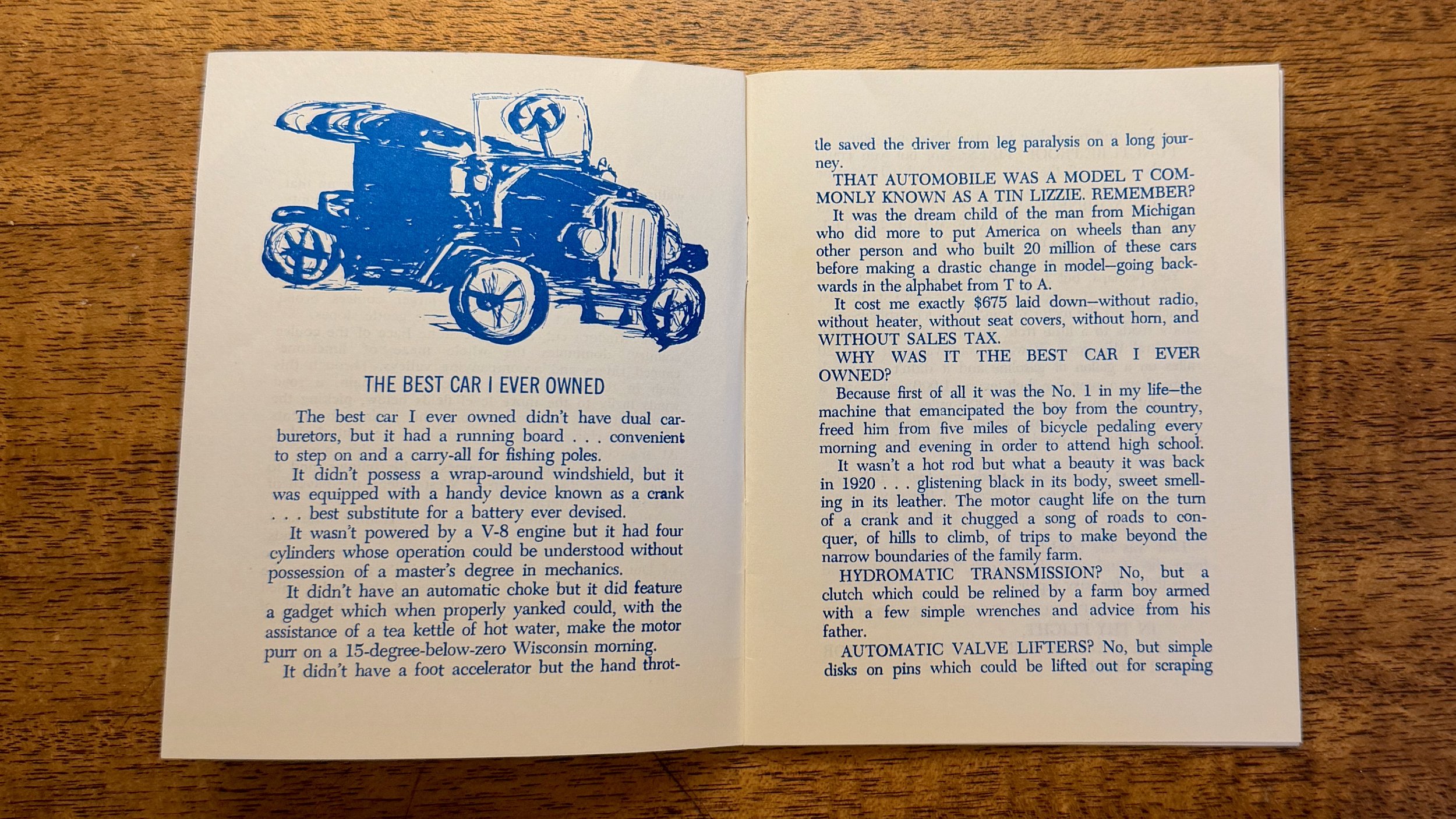
THE BEST CAR I EVER OWNED
The best car I ever owned didn't have dual carburetors, but it had a running board . . . convenient to step on and a carry-all for fishing poles. It didn't possess a wrap-around windshield, but it was equipped with a handy device known as a crank . . . best substitute for a battery ever devised.
It wasn't powered by a V-8 engine but it had four cylinders whose operation could be understood without possession of a master’s degree in mechanics. It didn't have an automatic choke but it did feature a gadget which when properly yanked could, with the assistance of a tea kettle of hot water, make the motor purr on a 15-degree-below-zero Wisconsin morning.
It didn't have a foot accelerator but the hand throttle saved the driver from leg paralysis on a long journey.
THAT AUTOMOBILE WAS A MODEL T COMMONLY KNOWN AS A TIN LIZZIE. REMEMBER?
It was the dream child of the man from Michigan who did more to put America on wheels than any other person and who built 20 million of these cars before making a drastic change in model—going backwards in the alphabet from T to A. It cost me exactly $675 laid down—without radio, without heater, without seat covers, without horn, and WITHOUT SALES TAX.
WHY WAS IT THE BEST CAR I EVER OWNED?
Because first of all it was the No. 1 in my life—the machine that emancipated the boy from the country, freed him from five miles of bicycle pedaling every morning and evening in order to attend high school.
It wasn't a hot rod but what a beauty it was back in 1920 . . . glistening black in its body, sweet smelling in its leather. The motor caught life on the turn of a crank and it chugged a song of roads to conquer, of hills to climb, of trips to make beyond the narrow boundaries of the family farm.
HYDROMATIC TRANSMISSION? No, but a clutch which could be relined by a farm boy armed with a few simple wrenches and advice from his father. AUTOMATIC VALVE LIFTERS? No, but simple disks on pins which could be lifted out for scraping of carbon and regrinding in a two-hour operation.
PUNCTURE-PROOF TIRES? No, but you could tear the casing off the rim, apply a patch which came in a can, and be on your way in 20 minutes.
DO IT YOURSELF? WHY THE MODEL T WAS THE FIRST TO ENCOURAGE WHAT IS COMMONPLACE TODAY IN AMERICA.
Only fond memories these? Yes, perhaps, but I can close my eyes and still see my first auto . . . see it carrying me—with its muffler detached and the motor roaring like a jet airplane—over sandy roads to a little trout stream in Monroe County of central Wisconsin. It was a conveyance—it went 20 miles on a gallon of gasoline and it didn't ask much more than a new fan belt every 1,000 miles and a new clutch covering every 5,000 miles.
It was the car of my dreams, the chariot winging me away from the menial chores to the halls of higher education. The sense of possession made me feel I belonged, made me glow inside and dream of the day when I might be driving one of those long and low Hupmobiles.
That was the Model T, the best car I ever owned from the standpoint of low cost, long operation and accessibility for easy repair.
BACKWARD, TURN BACKWARD, O TIME IN THY FLIGHT, GIVE ME A MODEL T AGAIN, JUST FOR TONIGHT.
YOUTH (Written as a class editorial Sept. 30, 1926 at the University of Wisconsin)
Grownups are prone to forget. They forget that youth is a time of braggadocio, a time when the youngster joins with his companions in smoking corn silk in a homemade corn cob pipe, not because he enjoys the comfortable sensation of smoke biting his tongue and parching his throat, but because he wants to brag of what he has done.
This world would be a drab living room if it weren’t for youth. Half of the day-dreams which have become realities were conceived in youth. We have a suspicion that Commander Byrd gained the North Pole several times in his youthful dreams. He probably disclosed them to some of his elders and was laughed at. Thereupon, he kept his dreams to himself and waited.
Some people say that youth is too impatient, but they never realize how long youth cherishes a dream and nurtures it until it is fulfilled and heralded as an achievement. Will dreaming, bragging youth ever be understood?
(Almost 40 years later we concede anew that youth will never be understood)
THAT MASON JAR (A "Word Pictures" speech delivered before the Mount Prospect Toastmasters Club. It was voted the best speech of the evening.)
This is just a common mason jar, fellow toastmasters, one like your mother used to fill with jam or preserves. It is a jar which stores a few memories of my boyhood, some word pictures I would like to share with you.
The jar carried me back to the kitchen of a farm house where mother was busy making preserves. The stove was hot and the kitchen was as sultry as the day. The contents of the kettle simmering on the stove gave off delectable odors and I watched as mother carefully stirred the contents. I paused to admire the jars which were set in orderly rows on the kitchen table as they were filled. I liked to hold them up to the light and see the beautiful colors stolen right out of nature's own palette. There were deep crimsons from the strawberries and golden ambers from the peaches.
My reveries were broken by the pleas of mother to bring in more wood to stoke the cookstove fire.
Then, I had good intentions as I started toward the woodhouse but I passed the old iron-handled pump and gave it two or three jerks and cooled my hands in the water gushing from the well-worn spout. A languid feeling in my young body dissipated all energy. I sauntered across the grass dropped down on the good and warm earth, arms outstretched, knees up and feet at rest. High up under the blue sky, as viewed from the holes in the straw hat resting over my eyes I saw the little clouds floating in leisurely procession and assuming fantastic, ever-changing forms which broke into lacy fragments in the distance. My attention was arrested by the flight of a hawk. I watched the gentle, rhythmic stroke of its wings, elevated my extended arms, opend my palms and made a motion like the bird, wishing I too could fly.
There was a stillness about me interrupted only by the buzz of the bees and the sound of the insects in the grass close to my ears. A drowsiness stole over me as muscles became relaxed. I heard the sound of a carpenter’s hammer and then an echo. I was in the thrall of that borderland between waking and sleeping—when time stands still. And then I heard a disturbing intrusion that at first sounded far off and then nearer and nearer: "Son, how many times do I have to call you—the woodbox is empty."
Yes, as I was saying, this old-fashioned mason jar gives me an opportunity, just as it might you, to recall the days when your youth, and not knighthood, was in flower.
CORN HUSKING MEET WAS WORLD SERIES OF AGRICULTURE (Written for the Kewanee Star-Courier centennial edition of July 13, 1954)
Corn husking by hand as a competitive sport is a lost art . . . gone the way of Old Dobbin displaced by the mechanical age on the farm. Yet thousands once watched, more than ever saw a Notre Dame-Army football game.
The husking contests were the world series of agriculture and the farming area around the now 100-year-old Kewanee was the cradle of champions in nurturing strong-wristed men who won with honest sweat on their dusty brows and a creak in their backs. It was hew to the bangboard then . . . let the shucks fall where they may.
As a reportorial youngster for The Star-Courier we knew something about this 80 minutes of grueling action—and no time-outs or feigned injuries—which flourished in the 1924-1940 era. Names still pop into our mind of men who doggedly tracked down the ears of corn in good weather and foul.
MEMORIAL DAY (An address delivered as village president)
Once again we are gathered in Lions Park for a ceremony which has survived the fading lines of the blue and the gray, two world wars, the Korean conflict and the cold war. The veterans of Mount Prospect have kept alive a ceremony which in the days of my youth was known as Decoration Day, an occasion for parades, family picnics and long orations.
Today, this should be an occasion for joy rather than sadness. It is a day for us to remember those who paid the supreme sacrifice for their country. But it is also a day for us to be happy that we have in this audience hundreds of young people—the Scouts, the Blue Birds, the Campfire girls and little leaguers. These are our children—alive, vibrant with enthusiasm, educated in the finest schools our community has ever known.
It is a day to rejoice that we have a free press to debate our national, state and community policies. It is a day for us to be happy that we are Americans who can speak out freely against the dangers of Communism and dictatorships.
It is a day on which to rejoice that those who have died in our nation's wars have not died in vain. So, let us not be sad on this Memorial Day of 1961. Let us rather pledge our hopes, our ideals and our future to these children in our audience. In them the honored dead of many wars live again.
HIS VALENTINE FOR 65 YEARS Stagg’s Love Story By C. O. SCHLAVER (Special to Chicago’s American)
STOCKTON, Cal. Feb. 14, 1960—St. Valentine's day, dedicated to romance, is a fitting time to report on the wedded bliss of Amos and Stella. They are principals in a love story of more longevity than any other in the world of sports.
Amos is of course Amos Alonzo Stagg, who at 97 is older than American intercollegiate football. Stella, 85, is his devoted wife who has been at his side for 65 years as game statistician, secretary, and nurse. They vowed on Sept. 10, 1894, to be “faithful until death do us part.” And so it has been for a longer time than is usually allotted.
Their honeymoon was spent on a special Pullman car attached to a train carrying a University of Chicago football team on an out-of-town trip. Now, they are living out the twilight of their years in a modest five-room cottage here, a few blocks from the College of Pacific campus where Amos coached for 14 years after he was told at 70 that he was “too old” for active grid tutorship on the Midway.
The nation's most legendary coach says it was never his ambition “to live to be 100,” although most people expect me to.” He adds: “I want to live long enough to look after Stella and Stella wants to look after me. We’re in love with one another and that is sufficient.”
Stagg doesn't sign autographs any more. His right arm shakes a bit he confides while explaining with a chuckle: “Must have pitched it out at Yale.”
This slight, white-thatched man with craggy features has kindly eyes now dimmed with infirmities of age. But those eyes once surveyed opposing batsmen without fear as he pitched for five championships at Yale, a feat of which he is perhaps proudest.
He turned with pride in the Stagg living room, jammed with mementos of the nation's longest coaching career, to locate a box enclosing 15 scuffed and time-blackened baseballs. The glass-covered case bears this notation:
Yale Champions, 1886, ’87, ’88, ’89, ’90 A. A. Stagg, Pitcher
A man with memories, living in a home which is to Stockton what the Baseball Hall of Fame is to Cooperstown, N.Y. That's Amos Alonzo Stagg today, slowly walking in. . . the yard or picking oranges from one of his trees . . . Thus life will go on with serenity at the home of Amos and Stella where time seems to stand still in a house chockfull of priceless memories. After writing this story, there came a letter with the signature of the late A. A. Stagg. It said in part: “Many thanks for sending me a copy of your article. Frankly, it is the best article which has been done concerning Mrs. Stagg and me. We appreciated your writing such a kindly story. I was amazed that, with so many items mentioned, you were so accurate in what you had to say.”
Fun is like life insurance; the older you get, the more it costs.
All the world’s a baseball diamond. But too many people are stranded at third base. They were afraid to slide home.
Too many people believe that the economic facts of life can be banished by committing them to a government institution.
A successful politician is one who stands for what the people fall for.
Man is a creature of many contradictions: He gets drunk not because he likes it but because he can’t stand being sober; he is always in a hurry but never going any place that really matters because once getting there he is in a hurry to return . .
Too many of us forget that our sons tomorrow will take our seats in Congress, own our companies, run our towns. Perhaps they deserve a little more of our attention now.
Some of us belong to the metallic age—gold in our teeth, silver in our hair and lead in our pants.
A Favorite Prayer: It was offered by the Indian to the Great Spirit— Grant that I may not criticize my neighbor until I have walked a mile in his moccasins.
December 5, 1956 (Written for son, David, on occasion of his 14th birthday). So you're 14 today, David. You are entering the best years of your life as you inch upward in stature and your mind grows with your body, if you'll let it. You'll never quite appreciate these teen years, son, until you have left them behind. Grasp the opportunity to be yourself now because youth will never pass your way again. You have a gift of music and don’t neglect it because there are football players who make touchdowns and baseball players who hit home runs who would gladly trade the ability for the skill of sitting down to a piano and becoming the life of the party. You have the opportunity to study and prepare yourself for what is your choice of a vocation. Your dad and mother will not dictate what that profession is to be but they hope you'll train well for it. We hope you'll always have a sense of humor because the sourpuss always seems to be stumbling over obstacles he puts in his own path. We hope you'll always share experiences and companionship with your brother and sister . . . if their actions annoy you at times remember they haven't reached the ripe old age of 14. We hope you'll remember that soap keeps a body clean but it takes kindly thoughts to wash out evil from the mind. We hope you'll always give God an opportunity to be your friend in prayer. Perhaps this sounds like preaching David, but we meant it just to be a “chat” with you that can be kept tucked away somewhere for you to read on each succeeding birthday. Your dad and mother.
February 7, 1961 (Written for son, Paul, on occasion of his 16th birthday) Dear Paul: Today you are 16 years of age. It is perhaps the most important birthday you’ll ever celebrate. Why? Because you have reached that somewhat magical milepost which guides you on two roads, one of which you can take. The first is that popular road which the crowd of teen-agers might prefer. It leads to disregard for adults, the shrugging off of many responsibilities, the acceptance of things which are popular even if not advisable. Knowing you as I do, Paul, I think you will take the other road which is more difficult. It's a road which is sometimes strewn with boulders which make progress tedious. There will be hurdles of obedience to parents, teachers and others in authority. There will be stops for study when it would be more desirable to play. There will be times when you will be denied use of an auto which would speed you along the way. But when you take this second road, Paul, you'll be a better man at the end. Dad.
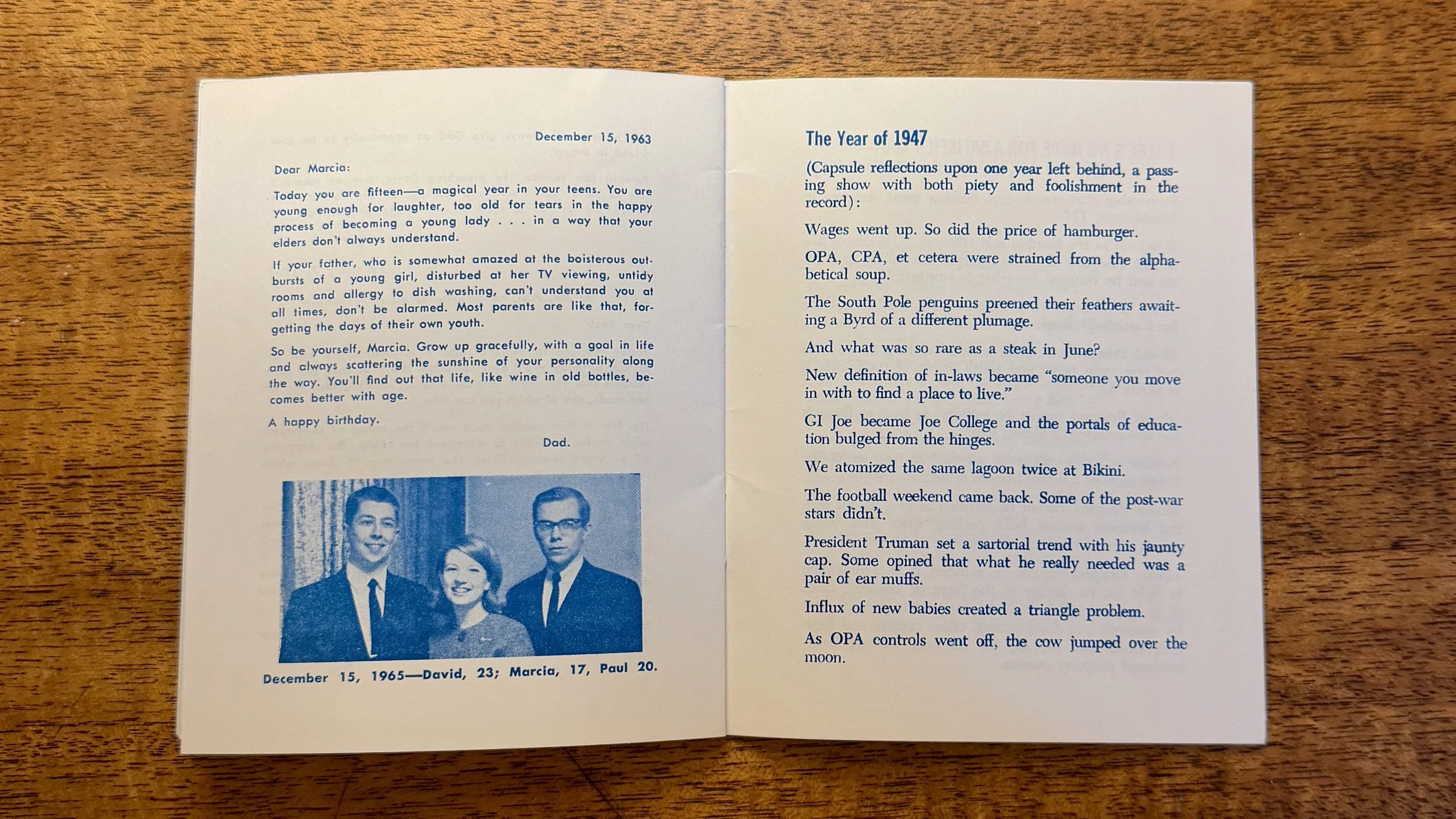
December 15, 1963 Dear Marcia: Today you are fifteen—a magical year in your teens. You are young enough for laughter, too old for tears in the happy process of becoming a young lady . . . in a way that your elders don't always understand. If your father, who is somewhat amazed at the boisterous outbursts of a young girl, disturbed at her TV viewing, untidy rooms and allergy to dish washing, can't understand you at all times, don't be alarmed. Most parents are like that, forgetting the days of their own youth. So be yourself, Marcia. Grow up gracefully, with a goal in life and always scattering the sunshine of your personality along the way. You’ll find out that life, like wine in old bottles, becomes better with age. A happy birthday. Dad.
[Photograph of David, Marcia, and Paul] December 15, 1965—David, 23; Marcia, 17, Paul 20.
The Year of 1947 (Capsule reflections upon one year left behind, a passing show with both piety and foolishness in the record): Wages went up. So did the price of hamburger. OPA, CPA, et cetera were strained from the alphabetical soup. The South Pole penguins preened their feathers awaiting a Byrd of a different plumage. And what was so rare as a steak in June? New definition of in-laws became “someone you move in with to find a place to live.” GI Joe became Joe College and the portals of education bulged from the hinges. We atomized the same lagoon twice at Bikini. The football weekend came back. Some of the post-war stars didn’t. President Truman set a sartorial trend with his jaunty cap. Some opined that what he really needed was a pair of ear muffs. Influx of new babies created a triangle problem. As OPA controls went off, the cow jumped over the moon.
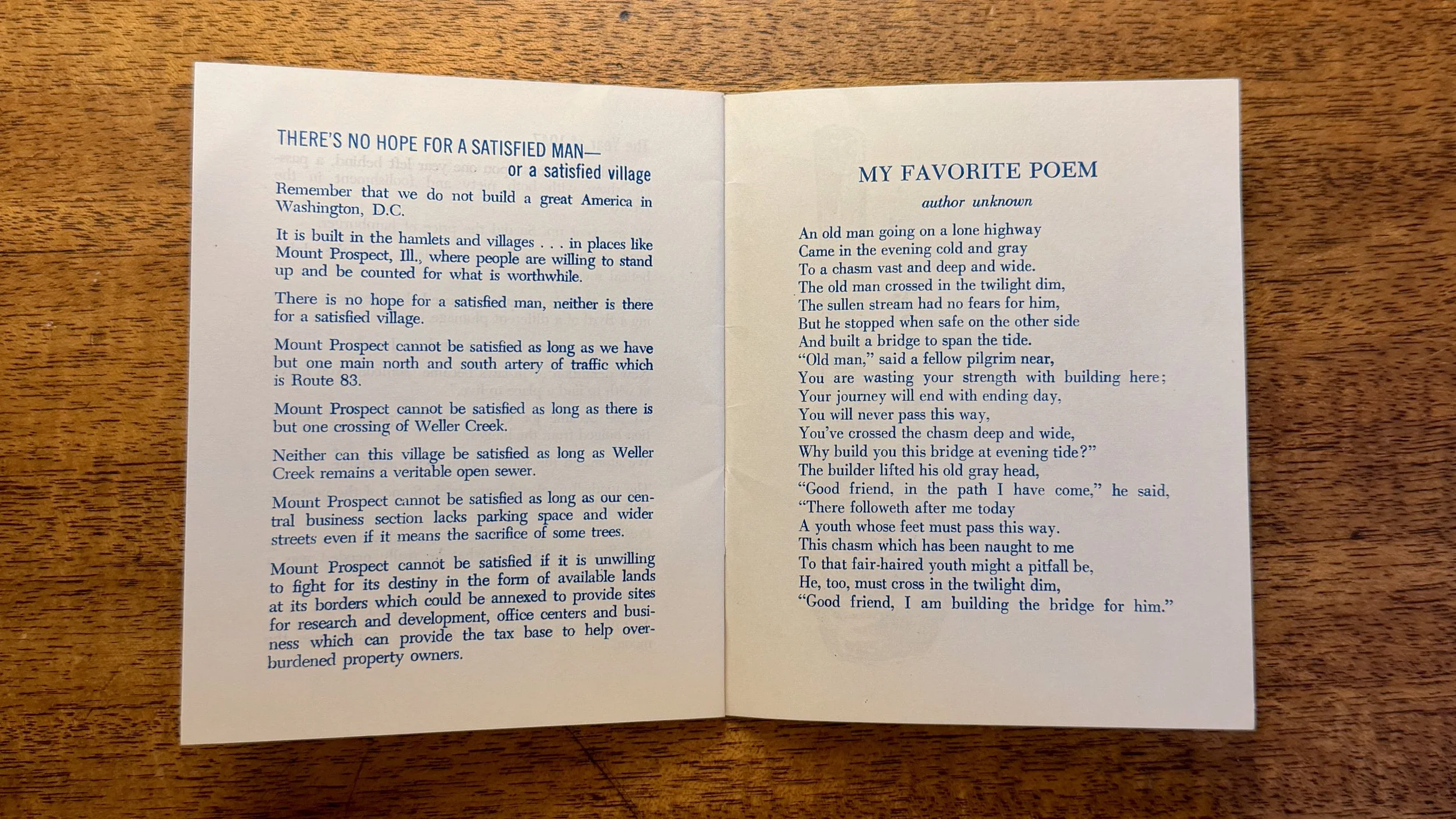
THERE'S NO HOPE FOR A SATISFIED MAN— or a satisfied village Remember that we do not build a great America in Washington, D.C. It is built in the hamlets and villages . . . in places like Mount Prospect, Ill., where people are willing to stand up and be counted for what is worthwhile. There is no hope for a satisfied man, neither is there for a satisfied village. Mount Prospect cannot be satisfied as long as we have but one main north and south artery of traffic which is Route 83. Mount Prospect cannot be satisfied as long as there is but one crossing of Weller Creek. Neither can this village be satisfied as long as Weller Creek remains a veritable open sewer. Mount Prospect cannot be satisfied as long as our central business section lacks parking space and wider streets even if it means the sacrifice of some trees. Mount Prospect cannot be satisfied if it is unwilling to fight for its destiny in the form of available lands at its borders which could be annexed to provide sites for research and development, office centers and business which can provide the tax base to help over-burdened property owners.
MY FAVORITE POEM author unknown An old man going on a lone highway Came in the evening cold and gray To a chasm vast and deep and wide. The old man crossed in the twilight dim, The sullen stream had no fears for him, But he stopped when safe on the other side And built a bridge to span the tide. “Old man,” said a fellow pilgrim near, You are wasting your strength with building here; Your journey will end with ending day, You will never pass this way. You’ve crossed the chasm deep and wide, Why build you this bridge at evening tide?” The builder lifted his old gray head, “Good friend, in the path I have come,” he said, “There followeth after me today A youth whose feet must pass this way. This chasm which has been naught to me To that fair-haired youth might a pitfall be, He, too, must cross in the twilight dim, “Good friend, I am building the bridge for him.”